


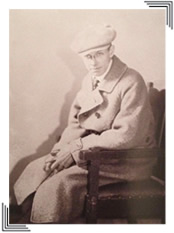
 Wayne Albee
1882-1937
"He is a poet of lines, a musician of tone values, a painter with the camera,
and a pictorial photographer whether he is found in his professional or
avocationary capacity."
_ Sigismund Blumann, in Camera Craft (1929)
WAYNE CLINTON ALBEE was born in St. Paul, Minnesota, the son of William C. and Ida E. Albee. At the age of six he moved with his parents to Tacoma, Washington, where he attended local schools. His interest in photography began early in his youth, primarily as a hobby until he reached the age of sixteen, when he began a more serious study in the field of portraiture. Around this time, Albee worked in the photographic supply store of Byron Harmon (1876-1942). Who relocated to Banff in 1903 and became an important photographer of the Canadian Rockies.
In 1900, at the age of eighteen, Albee produced a small book titled Characters of Evangeline using his mother’s paraphrased text derived from the Longfellow poem Evangeline and accompanied by his artistic photographs. By 1902, Albee had begun his professional career as a studio photographer in Tacoma while simultaneously developing his skill as a Pictorialist. As a member of the Photographers Association of the Pacific Northwest, his award-winning photograph The Bubble was reproduced in the January 1908 issue of Camera Craft. His work was consistently mentioned or reproduced in various national publications thereafter. In 1915, he was awarded the substantial amount of $450 for winning second prize in the national Camera Craft competition called America’s Loveliest Woman. He won an additional $100 for winning sixth prize as well. In 1911, he relocated and expanded his Tacoma studio, renaming it Ye Likeness Shop, which remained in operation until 1916. The following year, Albee moved to Seattle and operated a short-lived studio at 706 Pike Street until 1918, when he went into partnership with Ella McBride. McBride told the Seattle Post-Intelligencer in 1962 that she “got the photographic fever from him,” crediting Albee for her passionate interest in the success in the medium even though she had been close to photographer Edward S. Curtis since 1897.
Albee became the main photographer associated with the McBride Studio, along with assistants Frank Kunishige and Soichi Sunami. McBride herself had not actually been a photographer when she opened her studio and relied on her associates to teach her the craft. When the studio began working closely with the Cornish School of Allied Arts in Seattle, Albee and the others had access to some of the greatest modern dancers in the world. He produced several successful studies of the famed ballerina Anna Pavlova, who performed in Seattle several times, and as early a 1915. “When Mme. Pavlova comes to Seattle to fill an engagement,” wrote C.H. Hanford in Seattle and Environs, “her manager hastens to the McBride Studio to make an appointment with Wayne Albee. She considers his photographs of her the best she has ever had” (pp. 644-45). One of these studies appeared in the British edition of Vogue magazine in August 1923. In addition to Pavlova, Albee also produced artistic photographs of other icons of modern dance. These included Adoplh Bolm of the Ballet Russes, Doris Humphrey, Ted Shawn, and especially Ruth St. Denis, who commissioned him to photograph her troupe in California.
Albee’s high professional standing in the community is evidenced by his serving as chairman and judge for all of the Frederick & Nelson Salons in Seattle from 1920-1925. To avoid any conflict of interest, he declined entering his own work, with the exception of the fifth annual in 1924, when he and McBride displayed two photographs, each as a loan exhibit not eligible for competition.
Albee was honored with a solo exhibition at the Seattle Fine Arts Society in March 1922, just two months after his Portrait of a Player received the fourth- place award in a national competition sponsored by American Photography magazine. That same year, his work was included in the annual of the Pictorial Photographers of America, the noted organization based in New York.
Albee was a regular exhibitor in numerous important photographic Salons, and his work was reproduced in several publications before the formation of the Seattle Camera Club (SCC) in 1924. On January 28, 1828, the SCC held a farewell party for Albee before his move to first LaJolla, California, and the following year to San Diego. Although he was an ardent supporter of the SCC, it is known if he ever became a formal member, and he only exhibited with the club one time, in 1929. Following a short-lived but highly respected career in California, he died in his sleep on December 1, 1937. In the San Diego Union Sigismund Blumann eulogized Albee as “extremely sensitive and so modest that it has been difficult to learn of many important accomplishments. His place in photography demands attention.” After his untimely death, Albee’s photographs were scattered among the few relatives who survived him. He was an only child and never married.
Albee’s works are in the Cornish College of the Arts, Seattle; University of Washington Libraries, Special Collections, Seattle; New York Public Library, Jerome Robbins Dance Division; Washington State Historical Museum, Tacoma; J. Willard Marriott Library, Manuscripts Division, University of Utah, Salt Lake City. The San Diego Museum of Art once held a large collection of Albee’s photographs, but they were deaccessioned and sold at public auction in 1980.
Albee produced numerous photographs for Washington State publications, including three major series for The Town Crier: “The Rubaiyat,” December 13, 1924, pp. 17-25: “The Kings, an Interpretative Study of the Artist, a tribute to the poet Louise Imogen Guine, December 11, 1926, pp.17-22; and “Camera Studies by Wayne Albee,” December 14, 1929.