


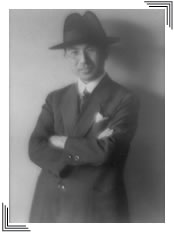
 Iwao Matsushita
1898-1979
Extract from Louis Fiset’s ‘Imprisoned Apart: The story of an Issei couple’.
Iwao Matsushita was born on 10 January, 1892 in Miike. Hiroshima prefecture. He was one of five children whose upbringing in a Methodist household exposed him to Western culture and awakened a keen interest in the English language.
Following graduation from Kobe’s Kwansei Gakuin high school in 1911, he entered the prestigious Tokyo Foreign Language College to study English language and literature for three years. Certificate in hand, Matsushita took became a high school teacher from 1914 to 1919 teaching English grammar.
Koike was an old friend of the family whom Hanaye called Uncle, the customary address for familiar elders, and had himself emigrated to Seattle in 1917. A physician with a medical practice located at 4221/2 Main Street in Nihonmachi , Seattle’s Japantown, Koike would play an important role in Matsushita’s creative life.
On 3 September 1919 the passenger freighter S.S. Suwa Mam entered Seattle’s Elliot Bay. On board were Iwao and his seven month old bride Hanaye.
They rented their first house at 1032 Main Street, which faced southward toward Mount Rainier. Through connections in the Japanese community, Matsushita found his first permanent employment with Matsui and Company. The year was 1920. Over time Matsushita’s duties and salary expanded to reflect his managerial value.
Photography and poetry writing quenched his creative thirst and, after his first outing to Mount Rainier, led by Koike, Matsushita would go on to visit this impressive 14,000-foot mountain for regular walks with his wife and Koike. They would take many photographs.
In late 1923 Koike co-organized the Seattle Camera Club. Matsushita became a charter member of the Club. Less gifted than others in the Club he was an artist whose hybrid style encompassed elements borrowed from numerous colleagues, especially from Koike, who he became to consider his mentor.
He enjoyed modest success, exhibiting prints in numerous salons throughout the United States and abroad. In 1927, six of his evocative images hung in four salons in the US and Great Britain.
It is thanks to Matsushita and his ties with the University of Washington after WWII that much of the works of Frank Kunishige and Dr. Kyo Koike survived. These important collections, along with those of Matsushita, form the core of the UW’s material belonging to the Seattle Camera Club.